
The last three weeks at Vancouver City Hall have been some of the busiest in years. With the new Official Development Plan (ODP) now in effect, Council is advancing large-scale, city-wide zoning changes, while many ODP-consistent residential rezonings are now moving forward without the traditional public hearing process. If you own land, are planning a project, or build in Vancouver, here's what actually changed and what it means for you.

Council accepted a referral report on June 2, sending the Vancouver Villages Planning Program to a Public Hearing on July 14, 2026. The program would rezone roughly 13,700 land parcels across 17 walkable neighbourhood hubs - local centres with shops, services, and housing up to six storeys, building on the "5-minute neighbourhood" concept from the 2022 Vancouver Plan. (The ODP envisions 25 villages in total; this first phase covers 17 of them.)
This is one of the largest single rezonings in the city's history. If your property is in or near one of these 17 villages, its development potential could change significantly - in some cases overnight. The smart move is to find out now whether your parcel is on the map, before the July 14 hearing.
Jay's Take:
This is big news. Rezoning roughly 13,700 lots is not a small adjustment - it could reshape entire neighbourhoods. But “up to six storeys” does not mean every individual lot can suddenly become a six-storey building on its own. For many owners, the real opportunity may come from working with neighbours, assembling sites, and checking feasibility early before assuming the land value has changed overnight.
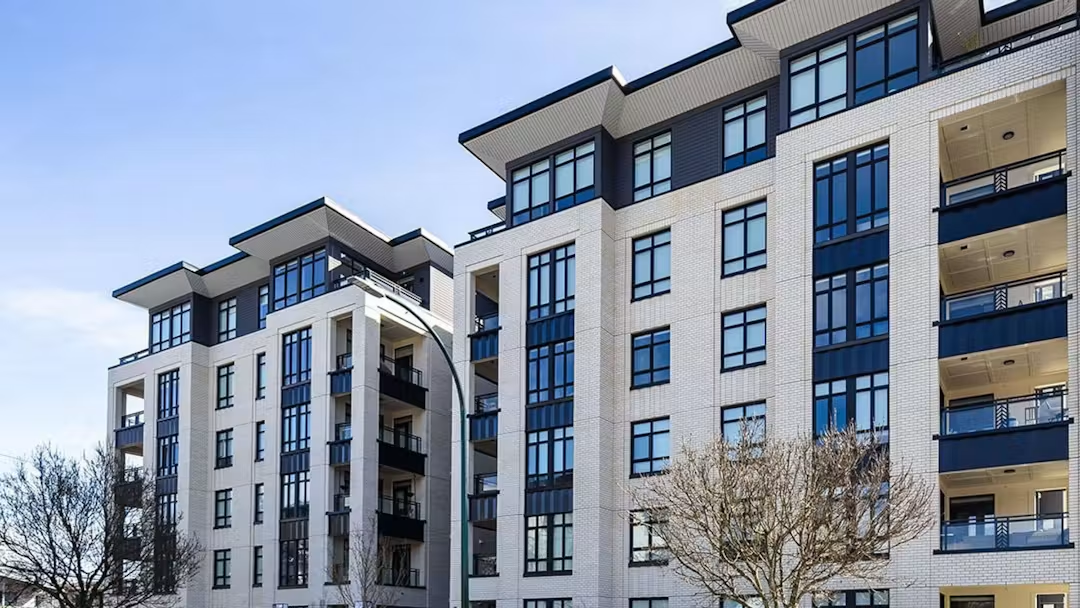
At the May 5 public hearing, Council approved a new C-2A district. It folds roughly 2,348 parcels - about 88% of the old C-2, C-2B, C-2C, and C-2C1 lots - into one simplified zone allowing rental housing and small hotels up to six storeys generally, and up to eight storeys in transit-oriented areas. Most sites are along Main Street, Fraser Street, Victoria Drive, and Kingsway, with some in the Broadway corridor.
The big shift here is prezoning. Qualifying projects can go straight to a development permit instead of a one-off rezoning - cutting months, sometimes more than a year, off the timeline. Density matches the existing C-2 standard: 3.50 FSR, or 3.70 FSR on corner sites. One thing to plan for from day one: non-residential uses are generally required at grade, with limited exceptions, and the C-2A framework does not permit hotel use to be co-located with housing.
For mixed-use and rental developers, this is the headline item of this issue. Removing the site-specific rezoning step is a genuine cost and time saver, and it de-risks early-stage deals on these arterials.
Jay's Take:
This is another big change. A lot of commercial lots are moving into the new C-2A zone, which could save real time by avoiding site-by-site rezoning. But owners still need to check the details before assuming what they can build.
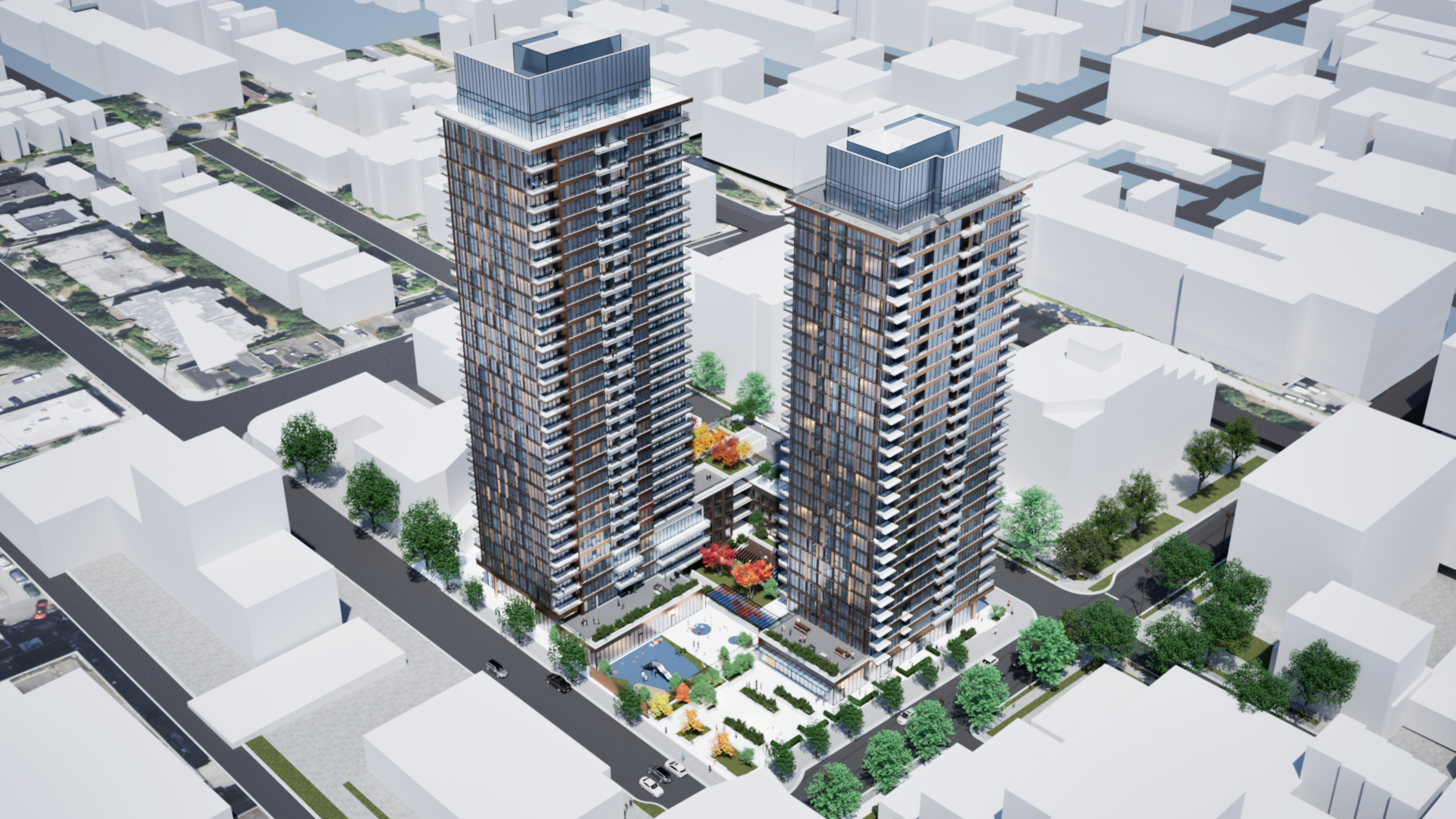
A two-tower rezoning at 1745 West 8th Avenue - by Amacon - went to Public Hearing on June 2 and was approved by Council on June 3: 29- and 31-storey towers, 441 strata units, 98 in-kind social housing units, and a 37-space in-kind childcare facility, at an FSR of 8.56. The Broadway Plan permits up to 26 storeys and 7.5 FSR for this site - this proposal exceeds both.
The takeaway isn't just the towers. The City supported above-Plan height and density where the revised proposal delivered a stronger public-benefit package, including social housing, childcare, and a larger privately owned public space (POPS). If you're working on a Broadway-area project, expect that benefit package to keep showing up as the benchmark for getting above-Plan density.
Jay's Take:
The city is willing to reward a strong community benefit package with density above what the Plan normally allows. Social housing, childcare, and public space are no longer nice-to-haves - they're becoming the reason a project gets approved. Since we work on many daycare projects, we know childcare needs to be planned properly.
On June 3, Council considered Licence By-law amendments - "Giving Effect to Cooling Rights in a Climate Emergency" - that would prevent landlords from prohibiting tenants from using portable cooling devices where no air conditioning or other cooling system is already provided. A limited exemption process exists where landlords can apply to the Chief Licence Inspector if significant physical barriers prevent compliance.
For owners and designers of rental buildings, this isn't just a tenant-rights story. Tenants generally not being able to be prohibited from using portable cooling devices has real implications for electrical capacity, window venting, building integrity, strata/rental rules, and envelope coordination. Planning for it up front is far easier than managing a building full of one-off exemption requests later.
Jay's Take:
After the heat dome years, this was coming. The question now isn't whether to plan for cooling - it's how to accommodate portable cooling devices safely without building integrity issues. Design in the electrical headroom on new rental projects now and save yourself years of one-off approvals later.
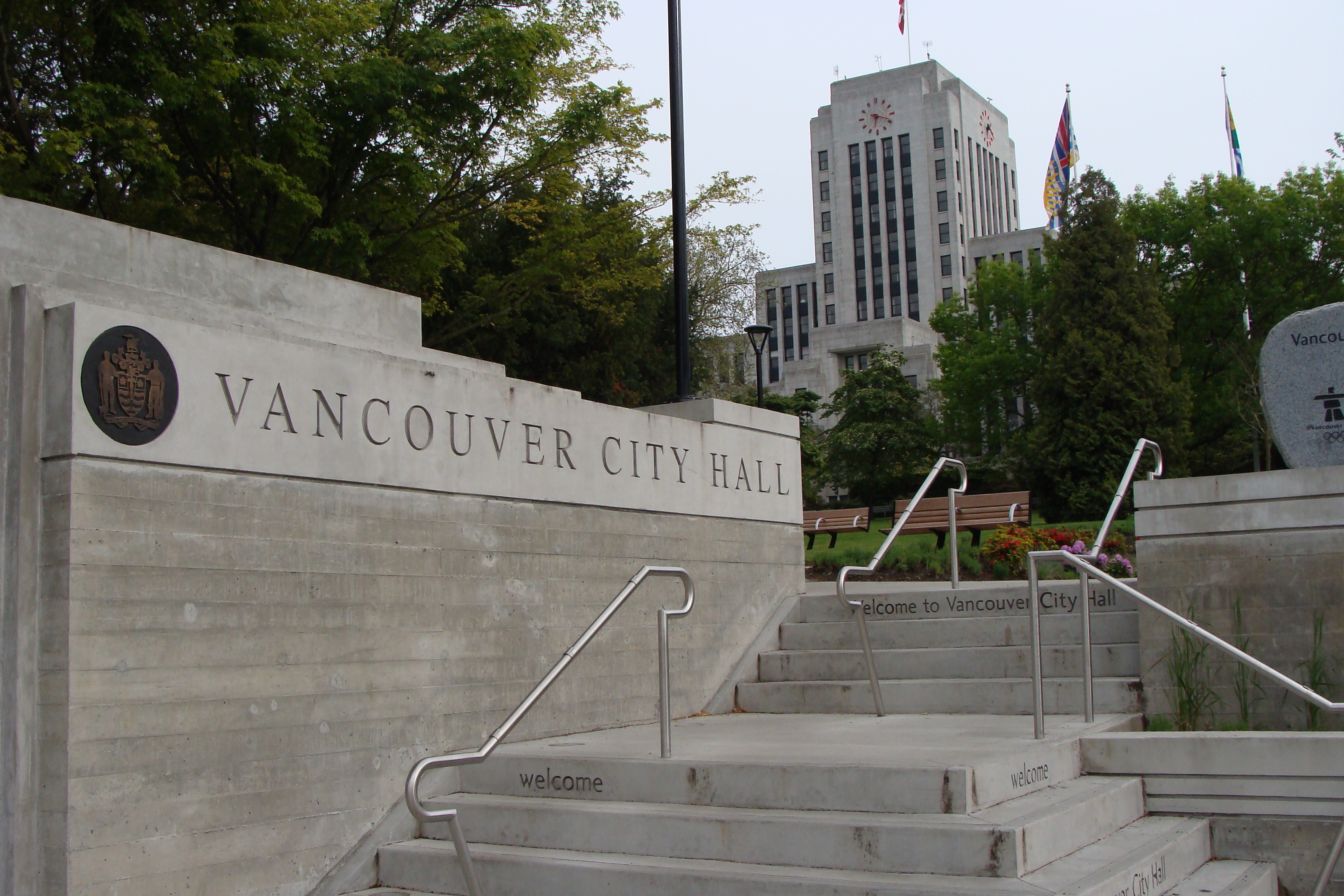
This one doesn't have a ribbon-cutting moment, but it may matter more than anything else on this list.
Under Bill 18 amendments to the Vancouver Charter - and now the ODP, which came into effect on March 31, 2026 - Council must not hold a public hearing for rezoning applications that are consistent with the ODP and where at least 50% of the proposed gross floor area is residential. Recent ODP-consistent residential rezonings can now proceed to a regular Council meeting instead of a public hearing, meaning there may be no public-hearing speaker list or public-hearing debate. For these files, the usual public-hearing correspondence package and speaker process may no longer apply in the same way.
The upside is real: faster, more predictable approvals for ODP-consistent projects. But the trade-off is that the public hearing - historically the moment to argue your case or flag concerns - is largely gone for these applications. Getting your project's land-use designation, FSR, and use mix right at the front end is no longer just smart practice. It's the whole game.
Jay's Take:
For our clients, this can be good news - fewer surprises and faster timelines. But it also makes early planning more important. With the public hearing step largely gone for ODP-consistent residential rezonings, architects play a key role in making sure the project aligns with the ODP, zoning, density, and rezoning requirements from the start.
Council also reviewed the 2026 Financing Growth Update (Bill 16 Compliance) covering Density Bonus and Inclusionary Zoning provisions. If you're modelling community amenity contributions into a pro forma for any Vancouver project, this is worth tracking.
These changes are moving fast, and they affect different sites in different ways. If you own land near a proposed village, are evaluating a C-2A site on Main or Fraser, or are working on a Broadway-area project and want to understand how these rezonings affect your options - we're happy to talk.
Jay Jung Architecture Inc. works across Metro Vancouver on multiplexes, mixed-use buildings, childcare facilities, and tenant improvements. Reach out to us at joon@jjarch.ca or visit jjarch.ca.
Sources: City of Vancouver council agendas & minutes (vancouver.ca, council.vancouver.ca) · Shape Your City Vancouver · CityHallWatch · Daily Hive Urbanized · STOREYS


