
If you own land, are building, or are evaluating a site in Burnaby right now, you are operating under a fundamentally different rulebook than you were two years ago. The city has spent since late 2023 systematically replacing a 1965 zoning bylaw with a modern, OCP-aligned framework - and the final chapter of that work takes effect July 1, 2026. Here is what changed, what is still moving, and what you need to know before your next project.
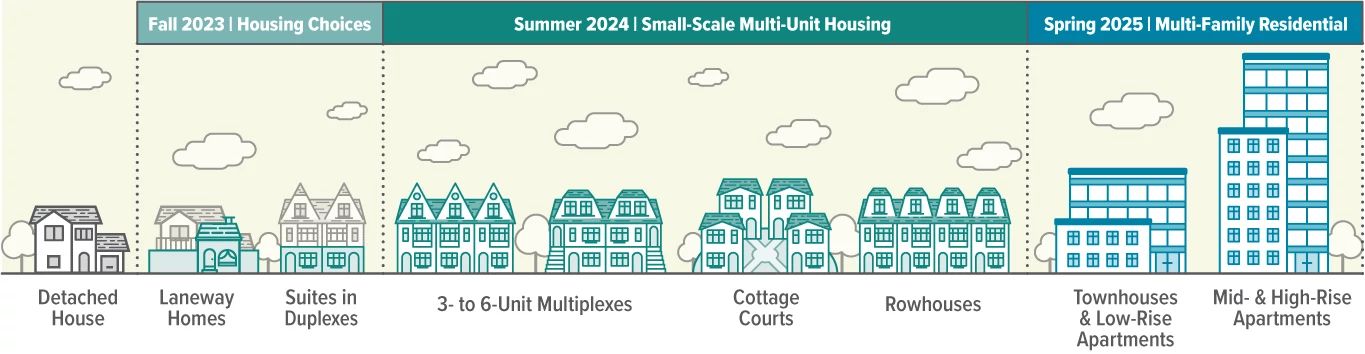
Burnaby's Zoning Bylaw Rewrite - the first comprehensive replacement of the city's zoning regulations since 1965 - is targeting adoption in spring 2026 with an effective date of July 1, 2026. This is not a set of incremental amendments. It is a full repeal and replacement of the bylaw, restructured around the Burnaby 2050 Official Community Plan (OCP) that Council adopted on December 9, 2025.
The rewrite was rolled out in four phases. Phase 1 brought the R1 Small-Scale Multi-Unit Housing (SSMUH) District into effect July 1, 2024. Phase 2 introduced a new height-based development framework and new multi-family residential and commercial districts. Phase 3 added new employment, industrial, institutional, parks, and agricultural zoning districts, adopted in March 2026. Phase 4 - the final supplementary regulations, administrative rules, and parking provisions - is completing now, with the full new bylaw set to go live July 1.
If you are mid-application or evaluating a site for a future submission, the transition date matters. Applications under the old framework may face a hard deadline. If you are planning something for 2027 or later, you are designing to the new bylaw - which looks very different from what came before.
Jay's Take:
If your project is already submitted under the old bylaw, it probably makes sense to keep it there. But if you are still in early design, do not rush to beat July 1. The new bylaw is cleaner and easier to work with. The ones to watch are projects stuck in the middle - early design under the old rules, nothing filed yet. Those are worth a quick review now.
One of the most significant structural changes in the rewrite is the shift away from floor space ratio (FSR) as the primary measure of development potential. Under the new framework, Burnaby uses building height as the organizing principle, eight residential districts running from R1 (ground-oriented SSMUH, up to 4 storeys) to R8 (high-rise, up to 40 storeys base)
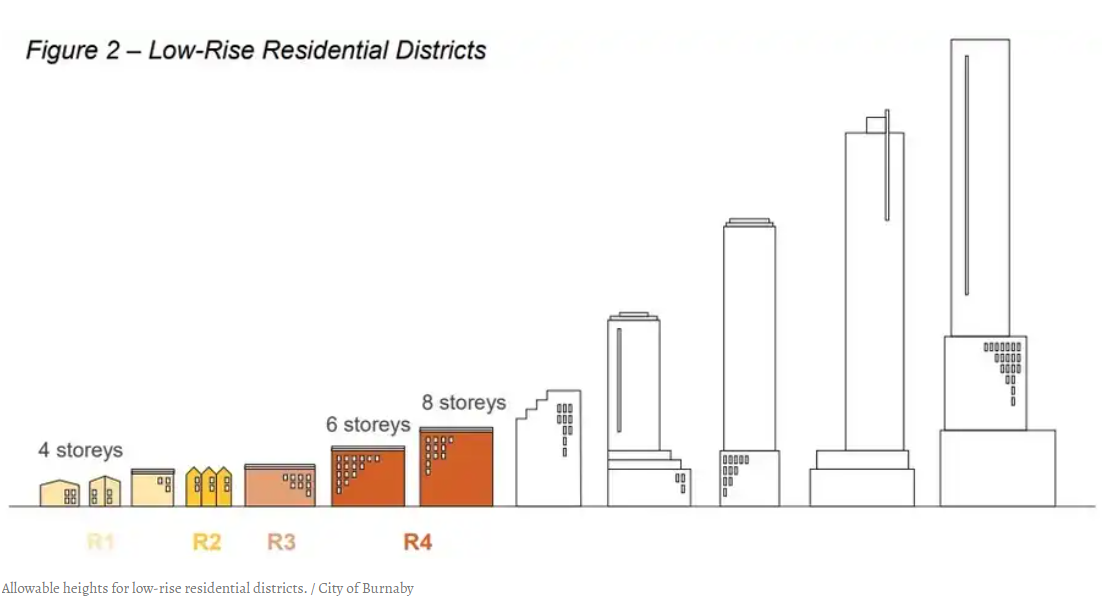
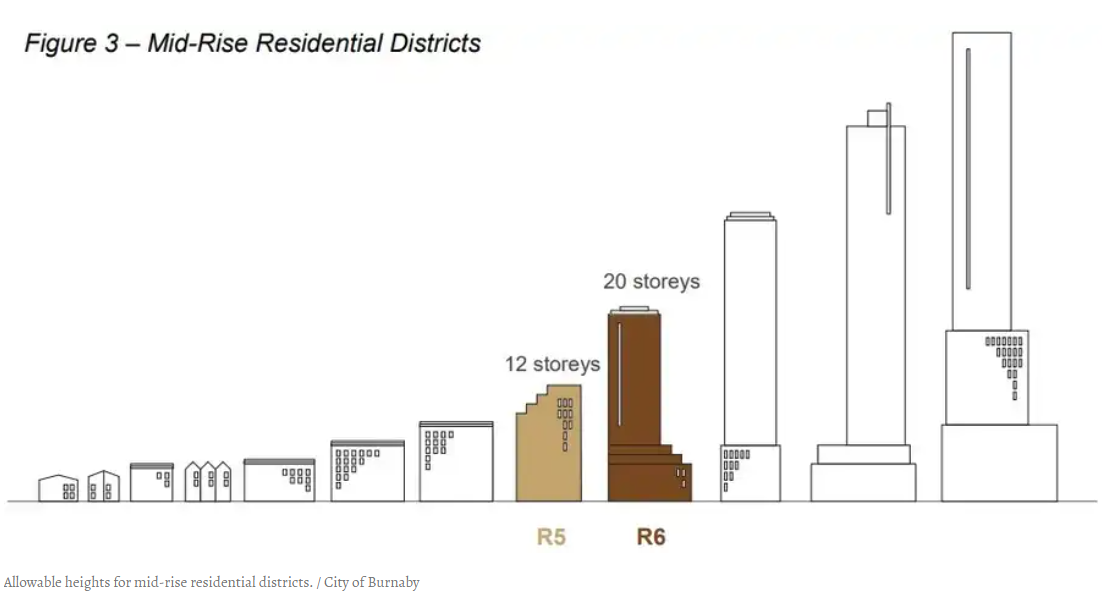
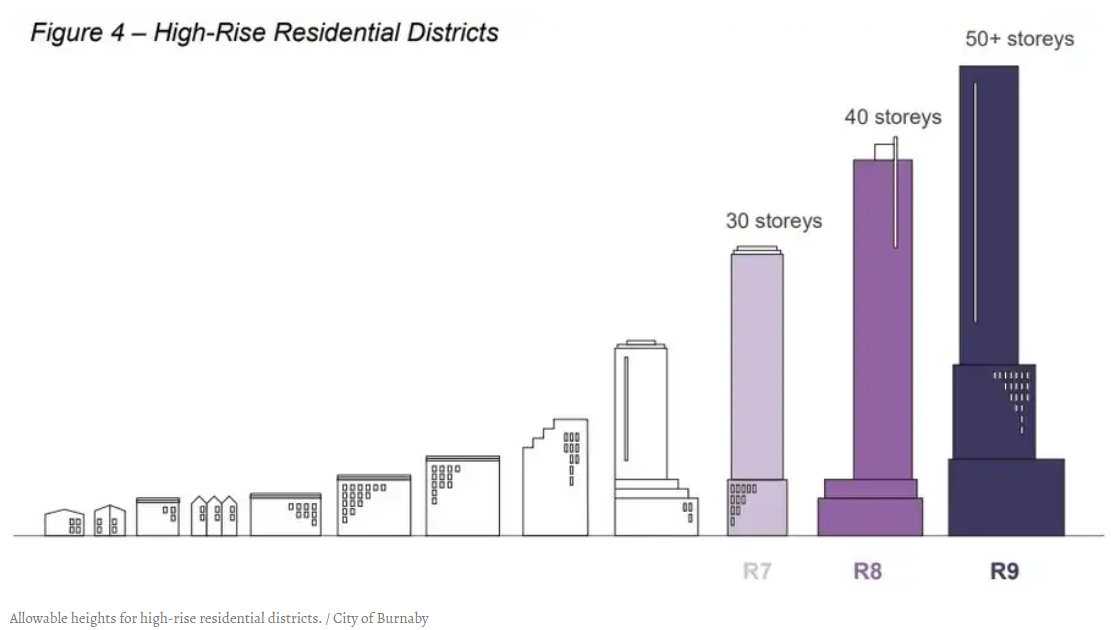
The full ladder: R1 and R2 allow up to 4 storeys; R3 up to 4 storeys (apartment form); R4 up to 6-8 storeys; R5 up to 12 storeys; R6 up to 20 storeys; R7 up to 30 storeys; R8 up to 40 storeys base. Two commercial districts - CM1 (neighbourhood commercial, up to 4 storeys) and CM2 (community commercial, larger scale) - round out the framework. Mixed-use sites use an overlay approach, stacking a residential district on a commercial district without stacking the height limits - so an R8/CM2 overlay gives you a commercial base with up to 40 storeys of residential above, not 80.
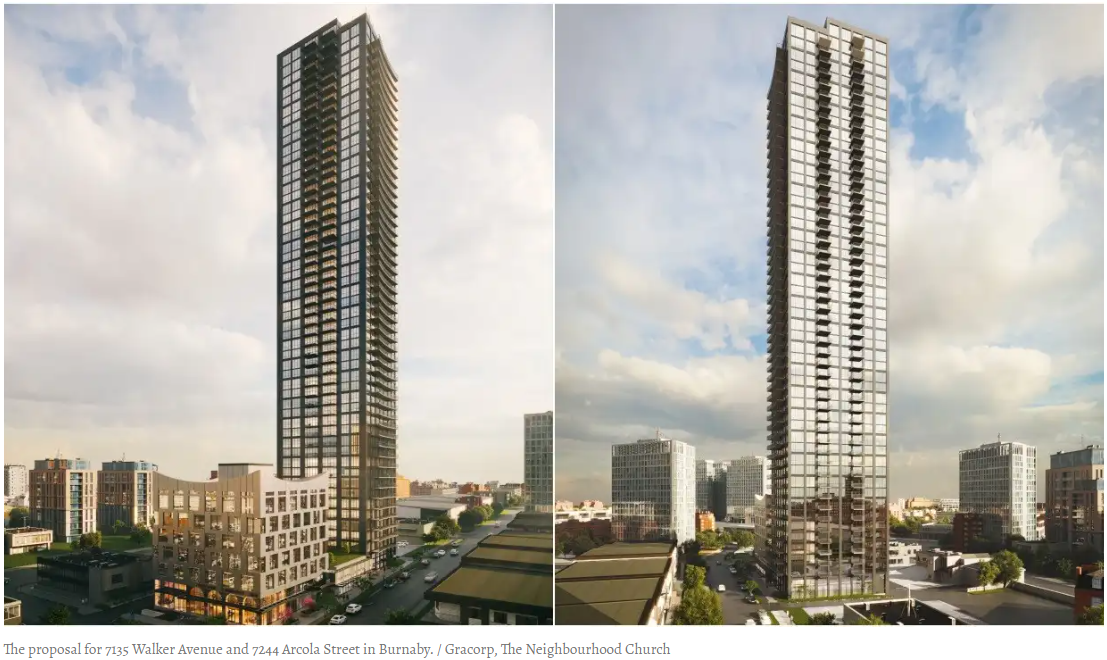
The first project approved under the new framework is a 50-storey rental tower at 7135 Walker Avenue - 384 market and 96 non-market units, part of BC Builds - which illustrates what the new height-based framework looks like in practice. For architects and developers, the city's pitch is predictability: look at the zone, know the height, design to it.
Jay's Take:
This is good news for architects. Height-based zoning is simpler to work with at the early stage - you look at the zone, you know the height, and you can start from there. It does not make the design easier, but at least the starting point is clear. Setbacks, floor plate, and unit mix still decide what actually fits on the site.
This change came into effect July 1, 2024, but its implications are still playing out on the ground. Burnaby replaced its 12 former residential R-Districts with a single R1 Small-Scale Multi-Unit Housing District. Single-family-only zoning no longer exists in Burnaby.
What you can now build without rezoning on an R1 lot depends on lot size and proximity to transit. Lots under 280 m2 allow up to 3 units; lots 280 m2 and larger allow up to 4 units; and lots within 400 meters of a frequent transit stop (SkyTrain stations or frequent bus routes) allow up to 6 units. The city also requires at least one 3-bedroom unit on lots with 1-3 units, and at least two 3-bedroom units on lots with 4-6 units - a family-housing floor built into the bylaw.
If you own a standard Burnaby residential lot and have not had a feasibility conversation recently, this is worth revisiting. A lot that was a single teardown two years ago may support a fourplex or sixplex today without any rezoning step - straight to building permit.
Jay's Take:
The zoning allows more units, but that does not mean the projects make money. Right now, building residential in BC is tough. Construction costs are high, financing is hard to get, and small infill projects are difficult to make work. The bylaw opened the door, but the economics have not caught up.
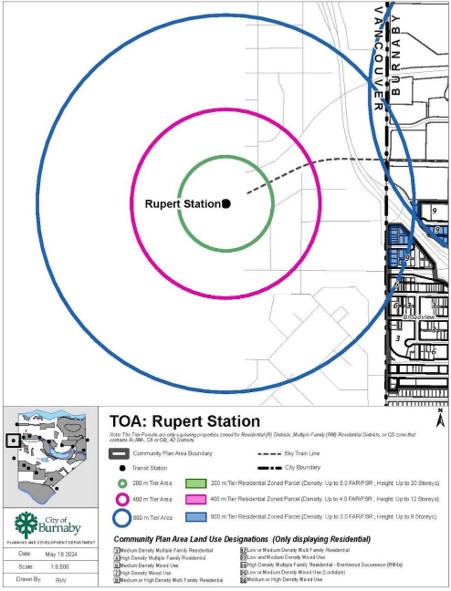
Burnaby adopted its Transit-Oriented Areas (TOA) Designation Bylaw in December 2024, formally implementing provincial Bill 47. Within 800 meters of every SkyTrain station in Burnaby, as-of-right heights must be permitted at 8 to 20 storeys depending on distance from the station. The TOA framework also eliminates residential parking minimums within those boundaries.
Burnaby's TOA bylaw covers 16 transit-oriented areas - 15 SkyTrain station areas plus Kootenay Loop Exchange - including Metrotown, Brentwood Town Centre, Lougheed Town Centre, Edmonds, Gilmore, Holdom, Sperling-Burnaby Lake, Lake City Way, Production Way-University, Patterson, and Royal Oak, along with cross-boundary areas at Rupert, Joyce-Collingwood, and 22nd Street. Several of these straddle adjacent municipalities. If your site sits within 800 meters of any of these, the as-of-right height entitlement and the removal of parking minimums both change the math on what is buildable.
One context note: Burnaby resisted implementing TOA legislation for several months in 2024, arguing it had already exceeded housing targets through its town centre model. The province denied a requested exemption. The bylaws are now in place, but the tension between Burnaby's historical approach and provincial density-around-transit requirements is still visible in how some individual applications are being reviewed.
Jay's Take:
We have not worked on Burnaby TOA sites yet, but this is something every owner near a SkyTrain station should be paying attention to. Being inside a TOA can change what you are allowed to build - height, density, parking - in ways that are not obvious just from looking at your address. If you are not sure whether your site is affected, give us a call and we can take a look.
Burnaby's inclusionary rental requirements have been in flux, and the numbers in your pro forma need to reflect the current rules, not what was in place 18 months ago.
In October 2024, Council reduced the inclusionary rental requirement from 20% to 15% of units at 20% below market rates. The current rate structure varies by quadrant: the city's western areas face a 10% inclusionary requirement, while eastern areas face 5%, with rates benchmarked to the CMHC Market Median. Non-market housing (affordable rental, non-profit co-ops) may be exempt from Amenity Cost Charges and eligible for a Development Cost Charge waiver. However, Burnaby's DCC waiver bylaw excludes rental units delivered under Stream 1 or Stream 2 of the Rental Use Zoning Policy — meaning inclusionary rental units under those streams may not qualify for the waiver, even when delivered by a private developer. This affects project viability on purpose-built rental in some locations, a point raised publicly by Bosa Properties in 2024.
The Community Benefit Bonus (CBB) program runs alongside inclusionary requirements and is tied to the new height framework. R3-R5 projects can access additional height through a discretionary CBB process; R6-R7 projects can access up to 10 bonus storeys through CBB; and R8 is uncapped for CBB bonus height. If you are underwriting any multi-family site in Burnaby right now, you need the current ACC and DCC rates, the current inclusionary rental percentage for your specific quadrant, and clarity on whether your project qualifies for any non-market waivers. Older pro formas will not be reliable.
Jay's Take:
More density does not automatically mean a better project. If you are looking at a multi-family site in Burnaby, make sure your numbers reflect the current fees and rental requirements. A lot has changed in the last year or two, and older estimates will not be accurate.
The Burnaby 2050 OCP Implementation Plan is expected to come to Council in 2026, providing a detailed roadmap for tracking and monitoring the city's new land use framework. Form and Character Development Permit Design Guidelines are also in a spring-summer 2026 final phase, which will shape what multi-family, commercial, and industrial development actually looks like under the new rules. And the city has received $43.4 million through the federal Housing Accelerator Fund (HAF), with a target of 11,000 new housing units by end of 2026.
These changes are significant and the details vary by site, zone, and quadrant. Thinking about how they affect your project? Jay Jung Architect Inc. works with developers, builders, and property owners across Metro Vancouver. Reach out at jjarch.ca or email jay@jjarch.ca.
Sources
City of Burnaby - Zoning Bylaw Rewrite: burnaby.ca/our-city/projects/zoning-bylaw-rewrite
Burnaby 2050 OCP: yourvoice.burnaby.ca/burnaby-2050-planning-our-city-together
City of Burnaby - Rental Housing policy: burnaby.ca/our-city/programs-and-policies/housing/rental-housing
City of Burnaby - Development Funding Program: burnaby.ca/services-and-payments/development-permits-construction/development-funding-program
City of Burnaby - Height-Based Framework announcement (July 2025): burnaby.ca/our-city/news/2025-07-17/city-burnaby-introduces-simplified-innovative-approach-zoning
City of Burnaby – Inclusionary Rental Requirements and Community Benefit Bonus: 2025-08-26 Proposed Inclusionary Rental and Community Benefit Bonus Amendments - Report
City of Burnaby – Proposed Inclusionary Rental Requirements: 2025-08-26 Proposed Inclusionary Rental and Community Benefit Bonus Amendments - Report
City of Burnaby – Proposed Amendments to Community Benefit Bonus Policy: 2025-03-11 Burnaby Proposed Amendments to Community Benefit Bonus Policy - Report
City of Burnaby – DCC and ACC for SSMUH: City-of-Burnaby-DCC-and-ACC-for-SSMUH-developments.pdf
Daily Hive Urbanized - Burnaby height-based framework: dailyhive.com/vancouver/burnaby-height-based-development-framework
Daily Hive Urbanized - Burnaby TOA bylaws approved: dailyhive.com/vancouver/burnaby-transit-oriented-development-bylaws-approved
STOREYS - Burnaby height-based framework: storeys.com/burnaby-height-based-development-framework
STOREYS - Bosa Properties letter on inclusionary zoning: storeys.com/bosa-properties-burnaby-inclusionary-zoning
Burnaby Beacon - Inclusionary rental reduction: burnabybeacon.com/p/city-plans-to-change-non-market-rental-requirements
UDI - Burnaby inclusionary rental and CBB: udi.org/advocacy/updates/city-of-burnaby-land-use-framework-and-inclusionary-zoning-policy
UDI - Burnaby new non-residential zoning districts (March 2026): udi.org/advocacy/updates/city-of-burnaby-new-non-res-zoning-districts-for-ocp
City of Burnaby - Housing (HAF award): burnaby.ca/our-city/programs-and-policies/housing
BIV - Province rejects Burnaby TOA exemption: biv.com/news/bc-rejects-burnaby-petition-for-exemption-to-new-transit-oriented-development-rules-8707000


